

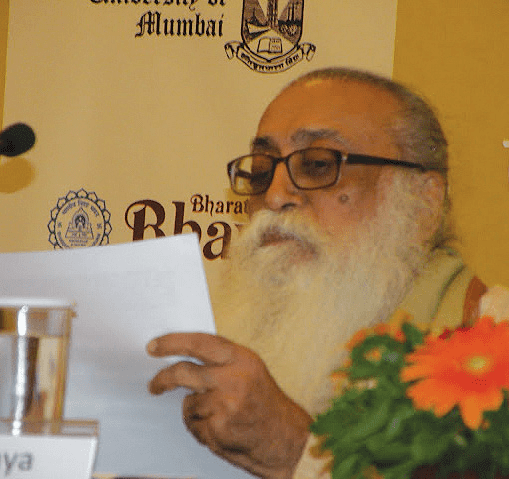
‘Guru,’ a word that has now gone global and, like everything that has been globalized (not universalized!), is losing its deeper meaning. Indeed! Guru, in fact, like all words that come from Sanskrit, has a root that already expresses the precious sense of the person to whom it is attributed as a title. ‘Gr’ – this is the root – carries the sense of light, of that which illuminates.
The guru is, precisely, “the one who lights the way,” who makes you see where you have to walk, and which direction to take. Guru is not a profession; rather, it is a reality, and you can never choose to be a guru. It is the others who define you as their guru. Only those who have had their path enlightened by someone really know how things are and who is the person who worked that almost magical way of being that happens in a mysterious and real way. Obviously, each of us has had his teachers or mentors in life, spirituality, profession, and we could go on. But the real guru is something else. He or she is a person who completely involves you, who gently enters your life and whom you can no longer do without, but without a passive dependence. The relationship with one’s guru, when it is true, leaves you free, deeply free. And, then, from a certain moment on, there is almost no need to talk between guru and shishya (student-follower). They understand each other even if they live on different continents. However, it is still difficult, almost impossible, for those who have not had this experience to explain who is a true guru, despite global inflation, which has affected this term, but has not affected the reality of the guru.
All that I have just described – and undoubtedly, a lot more – could sum up my experience with Prof. Sureshchandra Upadhyaya. This morning, as soon as I woke up, I received the news on WhatsApp, saying he had left for his journey to heaven. Upadhyaya-ji (the final ‘ji’ is a form of respect) was the epithet of the guru. And this was not so much for his beard and flowing hair, nor for his surname meaning ‘those who have studied the Upanishads,’ the sacred books of Hinduism, not even for the way he spoke with a fascinating style that you couldn’t help but follow, and that you could listen to for hours. But it was about his way of ‘being.’ Upadhyaya-ji was a guru. Dozens, maybe hundreds of people recognized him as such academically, within the prestigious Bharatiya Vidya Bhavan, an Indian educational trust institute in Mumbai, where he spent a lifetime training people in true Hindu culture. But, above all, he was recognized as a guru for his ‘being.’

I still remember our first meeting. I had just started working at the Italian Consulate in Mumbai and was sharing the office with an Indian colleague, a Zoroastrian woman who had become a Christian, and an Italian citizen. One morning, Upadhyaya entered our office and my colleague introduced him to me as her guru. I was struck by his penetrating gaze and, at the same time, his boundless serenity. He listened in silence, with sacredness. Then he said a few words. He came once a month, and my colleague never asked me to leave the office – even though I had always suggested leaving them alone – and this allowed me to understand some aspects of the relationship between them. A few months later, I decided to enroll in a colloquial Hindi1 course and, much to my surprise, I found Prof. Upadhyaya as my teacher. I began to understand what it meant to be a guru. He wasn’t just teaching me Hindi, but the whole way of being, the cultural, spiritual, and historical meaning behind a word or a phrase or a saying. His was a school not of language, but of culture and being. Our contact with each other continued for years in this context, with sporadic meetings on official occasions, but it was always very cordial and profound.
Then, through a friend, whom I had introduced to him so that he could get to know the Hindu world, the opportunity came to invite him to a meeting on the occasion of Chiara Lubich’s first visit to India. Theirs was a meeting of hearts and minds. I witnessed what it means for two people of different cultures and religions, one, a man, and the other, a woman, light years apart humanly speaking, to meet and understand each other perfectly beyond words, explanations, or anything else. From the very first moment – and this has been shared with me by both of them in totally different situations – they felt perfectly understood by the other and felt they understood each other perfectly. On several occasions, for different conferences, they have dialogued in private and in public. I happened to be almost always their interpreter and I had the impression that their understanding of each other was total, going beyond their bodies and minds. Once, Upadhyaya was shocked to learn about Jesus Forsaken,2 one of the cornerstones of Chiara Lubich’s Christian spirituality. He asked for the floor, and with great tact, describing himself as ignorant and unable to understand, explained that for him, it was unthinkable that a God could be abandoned. His speech was of exemplary humility and, at the same time, of great spiritual depth. Chiara felt personally challenged and wanted to answer in front of everybody in the conference, offering one of the most beautiful answers – perhaps the most beautiful and complete – ever offered on this point of her spirituality: a masterpiece of Catholic catechetics and dialogical refinement. In the end, the professor commented, “You, Chiara, understand what I have in my heart before I can understand it myself.”

This was Sureshchandra Upadhyaya. For me, he remains a friend, a father, and also a guru. I had taught Italian language in his institute for several years, thanks to a contract we had to signed with the Italian Ministry of Foreign Affairs. He played a decisive role in my experience in India and in my understanding of Hinduism, in the choice of my doctoral thesis for which topic he advised me, and I realized how right he was to suggest that. My personal relationship with him was, by then, beyond anything. In recent years, it was not possible to hear from him often; we had met two years ago, and he was already struggling to see and recognize people. But he had immediately recognized me – Catalano-ji as he called me. I was struck by the reaction I had this morning when I received messages of his death from several people in Mumbai and elsewhere. I felt a profound peace, as I had felt only on two occasions, the death of my mother and Chiara Lubich. I don’t feel that I’ve lost a guru, a friend, a father. I feel that I always have him by my side, and I would dare say, within me. Yet it’s difficult to explain, perhaps, the root of it all is in the root of the word, that ‘Gr’ which means ‘light.’ And that light follows us everywhere, we carry it inside us, and it leads the way.
Roberto Catalano
1 An Indo-Aryan language spoken chiefly in North India.
2 Refers to Jesus who, on the cross, felt abandoned by His Father, and cried out, “My God, my God, why have You forsaken me?” (Mt 27:46).